What is a Screw Type Chiller?
 July 30, 2024

Overview
- This article provides an in-depth look at air-cooled screw chillers, highlighting their components and operation.
- It details how screw compressors, evaporators, condensers, and other parts work together to achieve efficient cooling.
- With applications ranging from office buildings to industrial processes, it also offers guidance on choosing the right chiller based on capacity, efficiency, and space.
Chillers help maintain the right temperature in industrial and commercial cooling systems. They ensure the processes, equipment, and environments stay within optimal temperature ranges for smooth and efficient operations.
The air-cooled screw chiller is noted for its exceptional efficiency and reliability. It utilizes air-cooled condensers that efficiently reject heat to the atmosphere. Its screw compressor design provides reliable cooling with minimal energy consumption.
utilize air-cooled condensers that efficiently reject heat to the atmosphere. The screw compressor design is known for its high efficiency, providing reliable cooling with minimal energy consumption. Read on to learn more.
What is a Screw-type Chiller?
An air-cooled screw chiller uses screw compressors to compress refrigerant for efficient cooling. It operates by absorbing heat from the air or process fluid in an evaporator and releasing it through an air-cooled condenser. Its compact design and absence of cooling towers make it suitable for installations with limited space.
What are the Parts of Screw-type Chillers?

Screw-type chillers consist of several key components. These parts work together to ensure efficient cooling and reliable operation.
- Compressor: Utilizes advanced twin-screw technology. It compresses refrigerant gas, which increases its pressure and temperature to remove heat effectively.
- Evaporator: Absorbs heat from the process fluid, enabling the refrigerant to evaporate and cool the fluid before it circulates back into the system.
- Condenser: Responsible for expelling the heat absorbed by the refrigerant into the surrounding air.
- Expansion Valve: Controls the flow of refrigerant into the evaporator by lowering its pressure and allowing it to expand and cool.
- Controls: Oversees the chiller’s operation, including temperature regulation, pressure monitoring, and system diagnostics.
- Electric or Power Unit: Supplies the necessary power to generate the chilling effect.
How Does a Screw-type Chiller Work?
Understanding its operation involves examining three critical stages: compression, condensation, heat exchange, and expansion and evaporation.
Compression Process
This is the chiller’s central component. As the gas is compressed, its pressure and temperature rise significantly. This prepares the refrigerant to release its absorbed heat in the next stage, ensuring continuous cooling.
Condensation and Heat Exchange
The high-pressure, high-temperature refrigerant gas flows into the condenser. Here, the gas releases its heat to the surrounding air. This is achieved through fans that blow ambient air across the coils, enhancing heat exchange.
As the refrigerant cools, it transitions from gas to liquid. This step is crucial for completing the refrigeration cycle and preparing the refrigerant for the next phase.
Expansion and Evaporation
The liquid refrigerant moves through the expansion valve, where its pressure is reduced, allowing it to expand and cool. This cooled refrigerant enters the evaporator, absorbing heat from the fluid being cooled.
As the refrigerant evaporates, it removes heat from the process fluid, maintaining the desired temperature. The refrigerant returns to the compressor to start the cycle anew, ensuring continuous and efficient cooling.
Applications of Screw-type Chillers
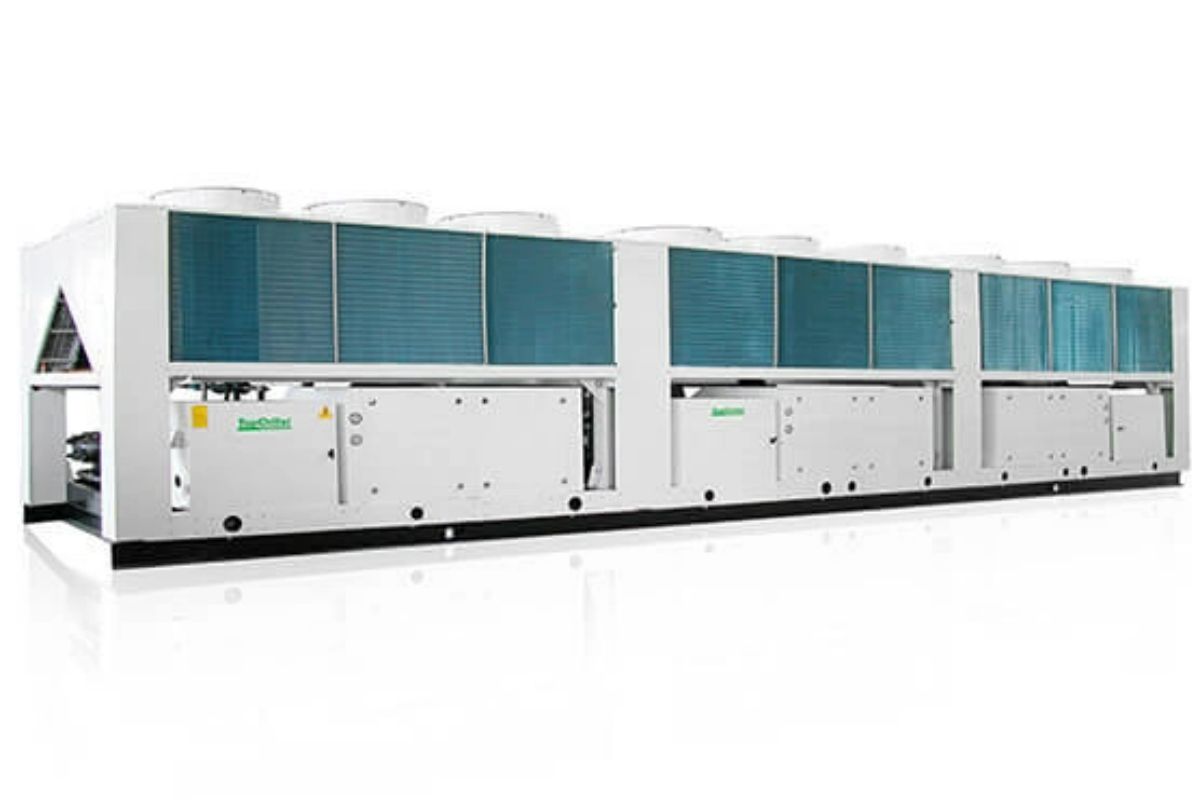
Screw-type chillers are used in office buildings, shopping malls, and hotels. Their capacity to manage substantial cooling loads makes them well-suited for environments, where temperature control is key to occupant comfort and the smooth functioning of equipment.
In industrial applications, these chillers are essential for processes requiring precise temperature management. They are used in various industries, including:
- Manufacturing: Regulate temperatures in production lines and equipment.
- Data Centers: Cool down servers and IT equipment.
Pharmaceuticals: Maintain controlled environments for drug production and storage. - Food and Beverage: Utilize for cooling during processing, packaging, and storage.
- Automotive: Manage temperatures in production facilities and ensure the proper functioning of equipment.
- Chemical Processing: Control temperatures in chemical reactions and processing.
How to Choose a Screw-type Chiller
Begin by determining the cooling capacity you need to ensure it performs efficiently. Evaluate the unit’s energy efficiency to save on long-term costs, and make sure it fits within your available space with room for proper airflow and maintenance.
Additionally, their reliability should be reviewed by investing in the brand’s reputation and warranty. These help you select a chiller that delivers excellent performance and cost-effectiveness.
Key Takeaway
As industries look to optimize their cooling processes, exploring the different options available in air-cooled screw chillers is crucial. By consulting with our experts at Industrial PH, you’ll receive tailored solutions to boost operational efficiency and sustainability in your cooling systems.
Achieve unmatched cooling efficiency with high-quality chillers from Industrial PH. Improve your operations and ensure reliable performance with our high-quality TopChiller products. Contact us today to discover how we can meet your cooling needs.